How the One-In, One-Out Rule helps you stop overspending
Discover how the one-in, one-out rule can assist travelers in managing expenses, minimizing clutter, and developing wiser habits.
The One-In, One-Out Rule to manage your spending
The one-in, one-out rule is one of the most effective methods for North American travelers aiming to curb excess spending without giving up style, convenience, or financial independence.
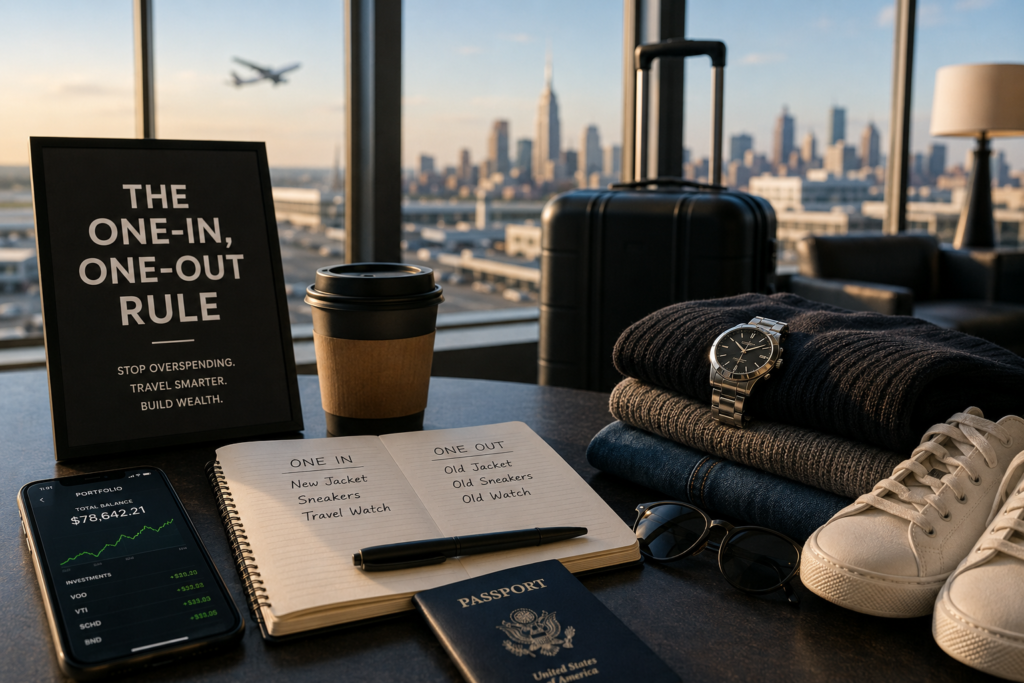
Even when consumers stay informed about investment trends and closely monitor Federal Reserve updates, they can still fall prey to impulsive purchases while traveling.
Why impulse buying happens during travel
As a frequent traveler, you might find yourself in New York, Chicago, Miami, Los Angeles, Seattle, or a variety of international cities.
You arrive in Paris and pick up a trench coat because it seems like “an investment in your personal style.”
You reach Tokyo and purchase gadgets because “Japanese technology is just superior.”
You stop in Austin and buy boots because “they fit the city’s vibe.”
It seems logical. But usually, it isn’t.
Data from the Bureau of Economic Analysis (BEA) shows that personal spending makes up about 68% of the U.S. economy, mostly fueled by discretionary buys linked to lifestyle choices, convenience, and aspirational upgrades.
Meanwhile, the Federal Reserve Bank of New York notes that revolving credit card debt in the United States continues to exceed $1 trillion, even among well-educated, high-earning individuals.
Our perspective is simple:
Today’s overconsumption isn’t driven by insufficient funds. It stems from lacking clear guidelines for spending.
And that’s precisely what the one-in, one-out rule addresses.
Here’s the way it functions.
What exactly does the One-In, One-Out Rule mean?
The Fundamental Rule of Asset Governance
Purchased new boots in Austin
Sell or give away an old pair
Is this worth your physical, financial, and mental space?
Got a new jacket? Donate or sell an older one to make space.
Picked up sneakers in Los Angeles? Let go of another pair.
Added an extra suitcase from Europe to your collection?
Get rid of similar items to balance it out.
The one-in, one-out rule isn’t about arranging things neatly.
It’s focused on managing your personal belongings. It demands asking one crucial question:
Is this item worth the physical, financial, and mental space it will take up?
Unless the answer is a clear and firm yes, don’t make the purchase.
The hidden challenge for the savvy traveler
🎭 The Cultural Identity Trap
“This piece reflects my experience in Milan.”
The RealityIt’s an emotional keepsake masked as sophistication.
“This gadget from Seoul holds emotional significance.”
The RealityIt’s romanticized excess without any real utility.
The U.S. Bureau of Labor Statistics reports that upper-middle-class American households spend thousands each year on non-essential items tied to fashion, technology, and travel-inspired lifestyles.
Yet, a large share of that spending yields little actual value.
These purchases often act as sentimental keepsakes, masquerading as signs of refinement.
This is precisely where the one-in, one-out rule helps guard you against impulsive buying.
The real financial cost of unfiltered consumption
💸 The True Cost of Unfiltered Spending
Average yearly travel spend: $10,500. Move the slider to discover what your impulse buys cost you over 20 years.
$4,200
$192,198
Why even savvy shoppers sometimes slip up
Many assume that just having the right information is sufficient. It isn’t.
The National Bureau of Economic Research (NBER) has consistently found that financial decisions are influenced much more by how choices are presented than by technical knowledge alone.
You might grasp valuation models, ETFs, and compound interest perfectly—and still end up buying a third black jacket in Manhattan.
Because knowledge alone doesn’t curb impulses. What curbs them is having a system.
And the one-in, one-out rule introduces an automatic framework.
Top practical uses for travelers
1. Quality Clothing
Before purchasing, consider: Which existing item will go?
If you can’t clearly identify one, hold off on buying.
You really don’t need it.
2. Technology
Americans tend to upgrade gadgets unnecessarily.
A new iPad. A new headset. A new camera.
This rule demands clarity: Which existing device will it replace?
If you can’t give a clear answer, don’t make the purchase.
3. Luggage
The U.S. market consistently promotes new upgrades.
Away, Samsonite, Tumi, and Briggs & Riley have all created strong aspirational brands.
Here is our candid opinion:
Tumi
- Remarkable durability
- Robust executive design
- Prices are often high
Great product. Value isn’t always great.
Away
- Contemporary aesthetics
- Brilliant aspirational branding
- Build quality lags behind marketing
Strong image. Narrative stronger than performance.
Briggs & Riley
- Exceptional warranty
- Excellent functionality
- Traditional design
The smartest practical buy. Less Instagram appeal.
The psychological impact that transforms everything
Researchers at Harvard Business School have demonstrated that decisions involving explicit costs help curb impulsivity. When purchasing entails “giving up” something you currently possess, your brain reevaluates the true benefit.
That’s exactly what the one-in, one-out rule achieves. It makes costs visible.
When costs aren’t clear, spending becomes automatic. When costs are clear, spending turns into a deliberate choice.
And making conscious choices leads to growing wealth.
The common error fashionable Americans often make
Many mistake collecting for curating. Lavish wardrobes often indicate a lack of true intention.
Accumulation
Owning 35 jackets. Purchasing impulsively. Rationalizing excess as “options”.
Poor filtering and consumption anxiety.
Curation
Owning 5 ideal jackets. Strict 1-in, 1-out policy. Buying intentionally.
Sophisticated taste and financial prudence.
Applying the rule while traveling internationally
Each purchase should clear three key checkpoints:
🛡️ The 3-Step Purchase Filter
Holding an item in a store? Check this test first.
You have to pass all three filters to move forward.
Financial outcomes after one year
Travelers who stick to the rule consistently notice:
- Reduced impulse buys
- Clearer understanding of assets
- Improved space utilization
- Decreased waste
- Increased available cash
This additional cash often gets funneled into:
- ETFs
- Enhanced travel experiences
- Meaningful upgrades
- Planned cash reserves
That’s smart wealth management.
Our honest conclusion
There’s a reason why many savvy consumers still end up financially average:
They confuse excess with identity. It isn’t—it’s just noise.
The one-in, one-out rule cuts through that noise and brings clarity back to spending.
Because deliberate spending is what truly defines financial wisdom.
Ultimately, style isn’t about having more possessions.
It’s about owning fewer, but better things.
Smart travelers know that true financial freedom is lighter in your luggage—and infinitely more valuable over time.