How to protect valuable belongings while living with less
Discover ways to safeguard your valuable possessions through intelligent systems, secure travel practices, and disciplined financial habits.
The hidden risk of living with valuable essentials
Protecting valuable belongings is one of the most overlooked financial skills among North American travelers who have embraced a lighter, more selective, and refined way of living.
Many believe that owning fewer possessions automatically lowers financial risk.
That’s not the case. In fact, the opposite is frequently true.
Owning less still means owning something valuable
When you decide to own fewer things, each item left usually holds more financial, practical, and emotional importance.
Someone who frequently travels between New York, Los Angeles, Miami, Chicago, London, Tokyo, and Paris seldom accumulates excess belongings.
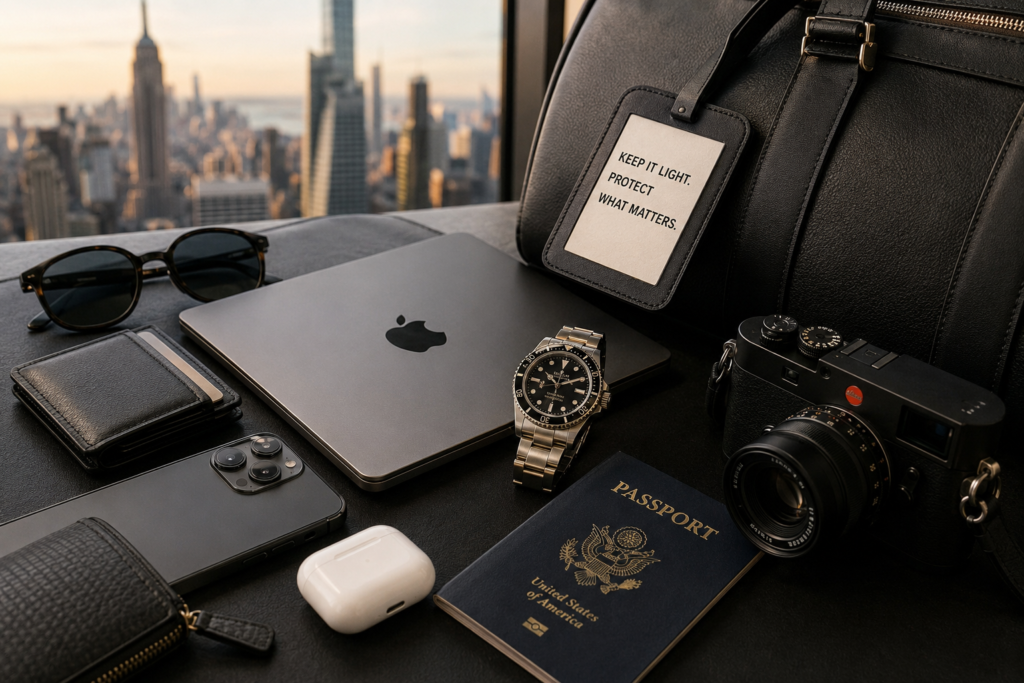
Rather, they usually focus on owning a small set of high-quality possessions:
- A high-end watch
- A professional camera
- A durable laptop
- Premium luggage
- Refined accessories
- Versatile, long-lasting wardrobe essentials
The issue is straightforward:
The fewer possessions you have, the bigger the financial loss if one goes missing.
Data from the U.S. Bureau of Labor Statistics reveals that highly mobile, affluent American households spend thousands yearly on durable goods linked to mobility, technology, and lifestyle efficiency.
Meanwhile, figures from the Federal Bureau of Investigation (FBI) indicate that theft and property loss continue to be major issues in crowded urban areas, busy airports, and popular international spots.
We take a firm stance: Minimalist asset ownership requires strict protection practices.
Those who overlook this are idealizing simplicity while risking their valuable possessions.
Why owning less demands smarter protection
A common error that financially savvy travelers make is mistaking simplicity for financial invulnerability.
Owning fewer things doesn’t necessarily mean you’re exposed to less risk.
In fact, living with less often leads to a more concentrated risk in your possessions.
🎒 Estimate Your Concentrated Risk
Input the estimated worth of the items currently in your carry-on bag.
$0
If this bag goes missing, this is your immediate financial loss.
Everything fits within just one carry-on bag.
If it goes missing, the financial loss can be significant.
This is why protecting valuable belongings should be seen as a key asset strategy, not just a logistical concern.
Check out how to create effective insurance plans for digital nomads.
The most expensive error experienced travelers make
People generally safeguard their financial assets more effectively than their physical ones.
They keep track of:
- Federal Reserve updates
- ETF returns
- Inflation rates
- Yield curve shifts
- Global portfolio balance
But overlook:
- Physical tracking tools
- Proof of ownership
- Digital backups
- Worldwide insurance plans
That lacks consistency.
The National Institute of Standards and Technology (NIST) points out that most modern asset losses stem from operational failures rather than a lack of technology.
Put simply: The risk seldom arises from not having the right tools.
Rather, it stems from lacking proper systems. And protect valuable belongings relies completely on having those systems in place.
Creating an inventory is your primary defense
🛡️ Inventory Readiness Audit
Review the items you have recorded for your premium gear.
You face a significant risk of claims being denied.
Usually, people only understand this once they’ve lost something.
An effective asset inventory includes:
- Serial numbers
- Purchase dates
- Digital receipts
- Current estimated value
- Detailed photos
- Videos
- Warranty papers
- Maintenance logs
The Federal Emergency Management Agency (FEMA) strongly advises keeping detailed inventories to support insurance claims and financial recovery.
This is even more important for those traveling internationally.
If your laptop goes missing in Lisbon or your camera is taken in Barcelona, having proper documentation speeds up every claim.
Without such documentation? You rely entirely on bureaucratic kindness.
That approach is never wise financial planning.
Top systems to safeguard your valuable belongings
Here’s our straightforward review of the most reliable tools preferred by savvy American travelers:
Apple AirTag
- Smooth ecosystem
- Very precise tracking
- Tied to Apple ecosystem
Top choice. The current gold standard.
Tile Pro
- Wide compatibility
- Simple setup
- Less robust tracking network
Good option, but not leading.
Samsung SmartTag
- Great for Galaxy users
- Limited use beyond Samsung
Strong, yet very specialized.
The common psychological error made by stylish travelers
Many Americans see their high-end belongings as part of who they are, which often leads to overconfidence.
They assume: “No one would dare take this.”
Or they think: “I’d realize it right away.”
But chances are, you wouldn’t.
The Transportation Security Administration (TSA) records thousands of lost-item reports every month at U.S. airports.
Many cases involve high-end items left behind by even the most meticulous travelers. Carelessness is seldom the cause.
This happens due to habitual familiarity. You ease up believing you’re in full control. That’s exactly when losses occur.
The Three-Backup Rule
This is a must-follow for every seasoned traveler:
🎒 Physical Backup
Use different compartments. Never store all your high-value items (laptop, passport, main credit cards, camera) in one bag. If one bag is lost, you still have backups.
☁️ Digital Backup
Encrypted cloud copies are essential. Use Google Drive, iCloud, or enterprise Dropbox. Your hardware can be replaced; your data cannot.
📄 Documentation Backup
Keep PDFs accessible offline on your phone: Receipts, serial numbers, and insurance policies. You’ll need these immediately when filing a police report abroad.
International insurance: a frequently missed asset
Americans often underestimate gaps in global coverage. This oversight can be costly.
Many believe homeowners insurance protects everywhere. Usually, it doesn’t or only covers limited losses.
Per the National Association of Insurance Commissioners (NAIC), international coverage exclusions differ widely among insurers.
Check the following before you travel:
🌍 The International Coverage Audit
Does your homeowner’s insurance truly protect you in Europe or Asia? Verify what you’ve checked:
Assuming your policy covers everything internationally can be a costly error. Premium assets need premium policies.
How smart style reduces risk
Few realize this: Smart style reduces risk by lowering asset visibility. Subtle items draw less attention.
Equipment without bold branding is less likely to be targeted by thieves.
Understated technical backpacks tend to be safer than flashy high-end luggage.
We firmly believe: Loud luxury is a poor choice for mobility.
True elegance goes unnoticed.
And that supports keeping your valuable belongings safe.
Loud Luxury
Bold logos. Instantly recognizable designer patterns. Flashy hardware.
Serves as a beacon for professional thieves in urban centers.
Quiet Luxury
Neutral technical fabrics. Unbranded exteriors. Premium craftsmanship.
Sophisticated protection without overt visibility.
The true test before each journey
Reflect on this:
“If I were to lose this today, could I handle it without significant financial harm?”
If the answer is negative:
Enhance your protection right away.The monetary impact of carelessness
Think about typical losses:
📉 The Projected Cost of Lost Gear
Enter the value of gear you might lose. Discover what that amount could have grown to if invested at 8%.
$0
Negligence inevitably costs future wealth. Without fail.
Our straightforward conclusion
Owning less and owning smartly are not the same thing. Many American travelers have mastered the former.
Few have truly mastered the latter. Protecting valuable belongings is not about materialism.
It reflects financial responsibility. It means being consistent.
It involves treating your physical possessions with the same care you give your ETFs, retirement plans, and tax strategies.
Ultimately, living with less succeeds only when the essentials you keep are truly safeguarded.
Smart travelers recognize this: freedom isn’t about carrying fewer things.
It means bringing only what truly matters—and guarding it as if it were your greatest asset.